One of the most fascinating transformations we witness every year is watching participants slowly take off their “student hat” and replace it with the much heavier helmet of a future founder.
Students around the world are given strict policies. They become remarkably skilled at bending rules, tweaking regulations, and turning loophole-hunting into an Olympic sport. But here is the catch: participants at kanthari are not here to become better students. They are here because they want to build and run their own organisations one day. And founders face very different challenges.
Students operate within systems. Founders create them, maintain them, and deal with the consequences when those systems break down. This difference becomes particularly visible whenever we discuss campus rules, usually during the first phase.
We can spend hours explaining why a rule exists. We can provide examples, scenarios, consequences, and examples from earlier years. Everyone nods. Everyone understands.
And then, in the past, sometimes even on the very same evening, some participants started brainstorming how to get around the very rule they just agreed was perfectly reasonable.
One recurring example, and a source of mild headaches for the team, is food delivery.
The kanthari kitchen prepares meals that are healthy, nutritious, and often surprisingly adventurous. Most participants appreciate the effort, the fresh ingredients, and the wonderful blend of Kerala and international flavours.
But homesickness occasionally strikes.
Someone misses ugali.
Someone dreams of fufu.
Someone longs for zaza.
And someone suddenly develops a deep emotional attachment to Kentucky Fried Chicken.
The moment dinner arrives without the desired comfort food, stomachs begin to panic, and perhaps as a lingering post-COVID reflex, fingers start twitching nervously toward the nearest food delivery app.
You may think: what’s the harm? Let them enjoy their favourite meal. Wish them “Bon Appétit” and move on.
Fair enough! In fact, participants are completely free to go out for dinner whenever they wish.
The challenge begins when food is delivered to campus.
Because every takeaway meal arrives with an invisible side dish: WASTE!
Pizza boxes covered in melted cheese and tomato sauce.
Containers coated with sticky gravies…
Chicken bones dripping grease…
Plastic wrappers decorated with chocolate cream…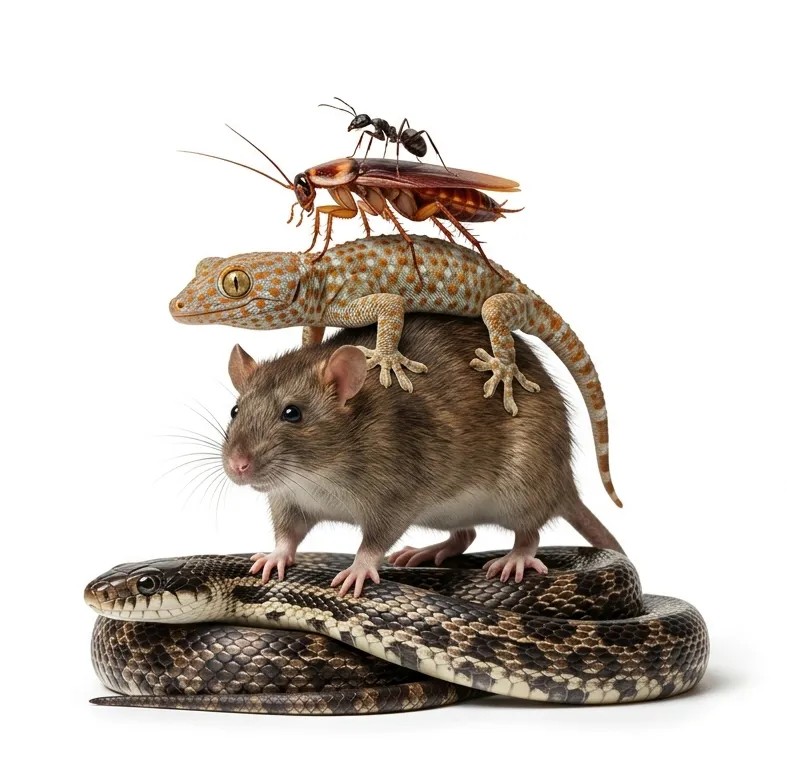
Paper bags filled with soggy French fries.
Disposable dirty cutlery.
Basically, all leftovers of convenience.
In some countries, people throw this waste away and they magically disappear.
Here, reality works differently.
We do not live inside a sophisticated waste-management vacuum.
Every improperly disposed piece of waste launches a festival of decomposers.
First come the ants. Their highway system is highly effective and usually leads directly to the room of the culprit. Then the cockroaches start organising themselves.
The geckos arrive to hunt the cockroaches. The rats follow everyone.
And because we happen to live in the tropics, where there are rats, there is good chance for rat snakes to peak around the corner as well…
At this point, the pizza that seemed like such a brilliant idea has evolved into a small ecological hazard.
To be fair, the ants, geckos, rats, and snakes are all simply doing their jobs.
The only species in this chain that occasionally struggles to connect actions with consequences is the human, and in this case, the founder(s)-in-training.
Which brings us back to the question: Why do rules exist?
Not because kanthari enjoyed creating them.
Not because we want to deny participants their beloved KFC.
But because every action creates consequences, and we believe future founders must learn to think beyond their immediate desires.
I remember a crisis meeting years ago in Tibet with our blind students. The children, aged six to twelve, were protesting against washing dishes. Fortunately, even back then, paul and I already believed in experiential learning. So, we agreed. No more dishwashing!
The first two days went surprisingly well, however then the stock of clean plates and cups ran out… The powerful Tibetan sun began warming the dirty plates scattered around the courtyard. A rather noticeable smell emerged which attracted a squadron of flies..
After preparing meals for the students, Paul and I decided to invite our house parents to enjoy some street food, outside the school. But at night we all started hearing high pitched squeaking sounds. Tibetan rats are considerably larger than their Indian relatives, and because they face relatively few dangers, they can become remarkably confident, and occasionally quite aggressive.
After enjoying the buffet in our courtyard, they began exploring the children’s dormitories in search of further entertainment. And by the third day, the children unanimously declared the experiment finished.
From that day forward, all dishes, pots and pans, cups and cutlery were cleaned with great passion!
Yes, we could try the same experiment here. But for some reason, most participants do not seem particularly eager to cuddle up with a snake in their bedroom.
So instead, we try to activate their imagination. Perhaps that is why one of the most important lessons at kanthari is not about social entrepreneurship at all.
It is learning the difference between a student and a founder.
Students ask themselves:
“How can I get around this rule?”
Founders ask: “Why does this rule exist, and what would happen if everyone ignored it?”
More kanthari blogs: