What a day! The campus is finally quiet because almost everyone has fallen fast asleep.
Only a few hours ago, participants were running from stall to stall, chasing donors, pitching their projects, and proudly presenting their newly developed concepts.
It was wonderful to see the confidence they had gained. But before they could speak so convincingly about their ventures, they first had to make their way through quite an obstacle course. And that obstacle course started with very small baby steps.
In fact, we began with something that every very young child does effortlessly: the ability to transform concepts, seamlessly switching back and forth between reality and fantasy. Once a toddler learns the word cup, it immediately recognizes cups everywhere, regardless of their colour, shape, size, or material. But when the child becomes bored or simply playful, the cup suddenly turns into a hut, a boat, or a racing car. At the same time, a closed hand, a curled-up leaf, or even the shell of a nut might also become “a cup.”
Every year we use this exercise with our adult participants, and every year it is astonishing to witness how firmly each of us has become attached to a single concept: a cup is an object used for drinking liquids. Then we want to apply the same concept to the project ideas of our participants.
In quite a few cases they react with: “Oh no… why do you do this to us?”
Because freeing ourselves from rigid concepts means becoming capable of questioning the status quo. And that is exactly the job of a changemaker. To do this, we must learn to unlearn. We need to question many of the concepts we have absorbed throughout our lives, from our parents, teachers, schools, churches, religious leaders, and the societies we grew up in.
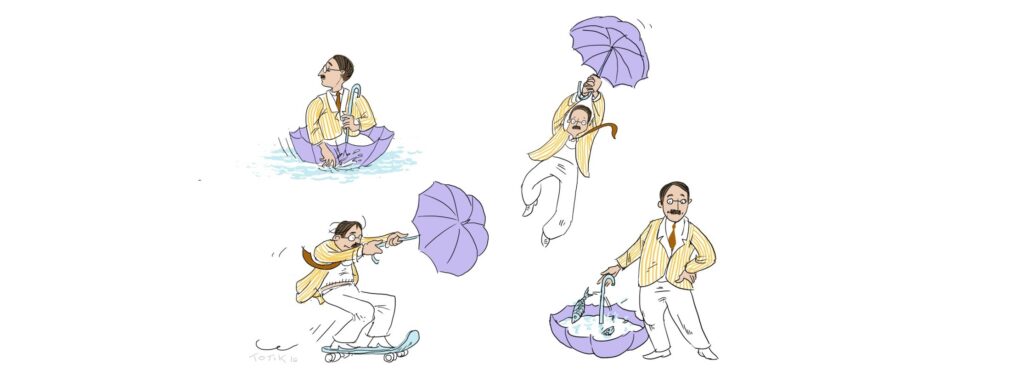
Questioning does not mean distancing ourselves from everything we know. It does not mean that change is automatically better. Nor does it mean looking at existing ideas with negativity. Questioning simply means remaining open to rethink, to explore, and, if necessary, to transform a concept. But this ability requires practice.
Natural questioners are children before they enter school. Yet once they become part of formal education, many gradually lose that wonderful ability to turn a cup into a boat.
During Act 1, we try to bring our participants back to that stage of curiosity. And there is hardly a better classroom than our lake. Working in groups of five or six, participants gather around a boat and fill it with invasive floating water plants and some discarded plastic bottles. While their hands are busy and their minds are gently distracted, seemingly impossible questions suddenly become playful exercises. Questions that remained unanswered in the classroom suddenly find surprisingly thoughtful responses in the cool breeze, under refreshing rain, or while watching a pink-and-turquoise sunset over the lake.
Among the questions they explored were:
• What is great about being a street child?
• What did waste teach you when you were a rag picker?
• How can silence be transformed into freedom?
After so many questions floating around, one final question remained:
When do we need to transform a concept?
The answers became obvious.
We need to transform concepts:
• when conventional solutions no longer solve old problems;
• when the parameters have changed and entirely new challenges emerge;
• when our ventures must evolve in order to survive;
• and when we want to remain flexible, dynamic, and capable of
discovering new possibilities.
Sometimes I cannot help thinking that these exercises should also be done with those
who hold the power to make decisions, CEOs, judges, politicians, and policymakers.
Let’s put them all around a boat in a lake, with a task to clean it together.
I have a strong feeling that many of today’s complex problems would suddenly receive much more thoughtful, creative, and valuable answers.
Read more blog posts here
Learn more about kanthari TALKS on https://kantharitalks.org/