From Dry Financial Figures to Spicy Workshops and a Cheese Factory on the Roof of the World
When it comes to this year’s group, it is almost impossible to avoid superlatives. Rarely have we had a group so lively and yet so divided. Rarely have participants been so willing to step into the washing machine and emerge with entirely new concepts. And never before have we seen a group swing so rapidly between extremes: from resentment and frustration to fun, and from sleepiness to complete attentiveness.
In short, this group keeps surprising us.
This became particularly clear during the third phase of Act Three. From the outside, the topics may not sound thrilling: bookkeeping, business finance, profit and loss, cost-price calculations, cash flow, financial projections, balance sheets and, finally, business plans.
Figures, tables and a mountain of technical terms. The kind of material that can make you fall asleep with your eyes wide open.
But then came Rohin.
I was sorry I couldn’t attend every session, but curiosity kept drawing me into the auditorium. What I witnessed was electrifying, in the best possible way.
Three whiteboards stood at the front. Facing them, the participants perched on the edges of their seats, determined not to miss a thing. In the middle was Rohin, darting between the boards, raising and lowering his voice, sometimes almost singing. With the enthusiasm of someone who had just discovered the world’s best-kept secret, he shared the magic of finance, double-entry bookkeeping and break-even analysis with participants thirsty for knowledge.
A long-awaited downpour after a lengthy dry spell!
Everyone was awake. And even if not everyone understood everything immediately, something happened that we had sometimes missed in other sessions: the participants made sure nobody was left behind. They helped one another, asked questions and showed that this mattered. Even when the material did not relate directly to their projects, they recognised its value.
I was deeply impressed.
Since we Social Business became a part of the Curriculum, we have probably never had a group so enthusiastic about finance. The credit goes to Rohin: to his passion and his gift for breaking complicated concepts into manageable pieces and presenting them as an intellectual game.
Which brings me to a question I have been considering for some time.
Why have we treated Act Three with a slightly less enthusiastic approach?
Perhaps because kanthari is, first and foremost, an institute for social change. We do not see ourselves as a business school with a social touch. Our starting point is not how to build the most successful business, but how to identify social problems, understand their causes and initiate change.
And I still believe that too much emphasis on business can seriously undermine social ideals.
Fundraising, for example, involves building partnerships and raising awareness. We need to help people understand a problem, explain its wider connections, make injustice visible and encourage others to join us in creating change. Business, by contrast, can quickly distract us from our mission. Suddenly, the central question is no longer what we want to change, but how to make money, grow and improve cash flow.
Of course, we have already debated these issues within our curriculum. One discussion explored whether social-change projects should be financed through income generation or through fundraising. Another examined microcredit: does it genuinely help people escape poverty, or can it create new forms of dependency?
I joined both discussions as a participant and raised my concerns.
Is business sometimes a major detour, or even a wrong turn, on the road to social change? Why not address the problem directly rather than first build a business model around it?
And do microloans really make people more independent, or merely replace one dependency with another?
These questions rarely have easy answers. But we must ask them if we want to avoid building an economically successful business while losing sight of the social goal that inspired it.
We have experienced how easily that can happen. And it happened on the Roof of the World.
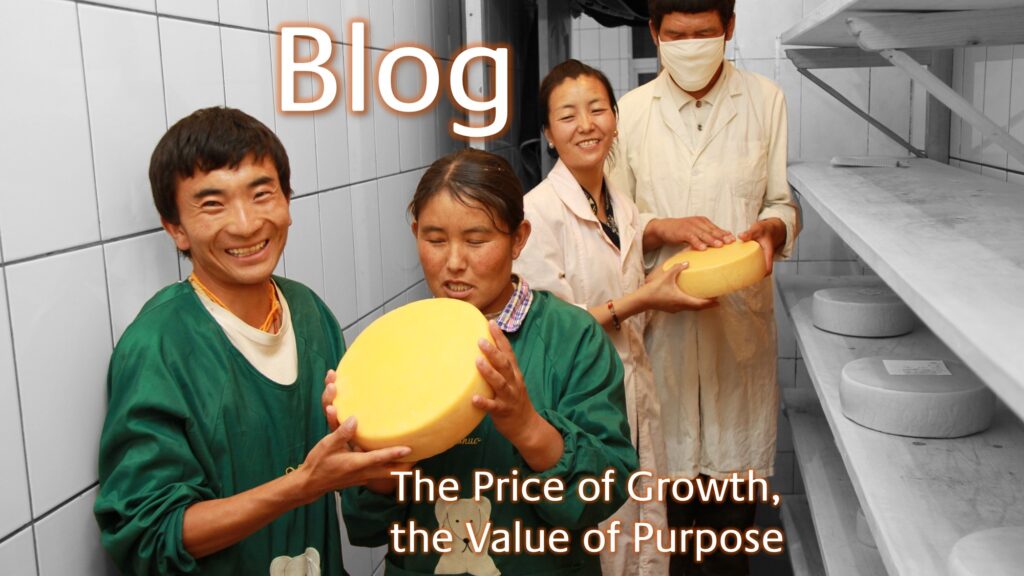
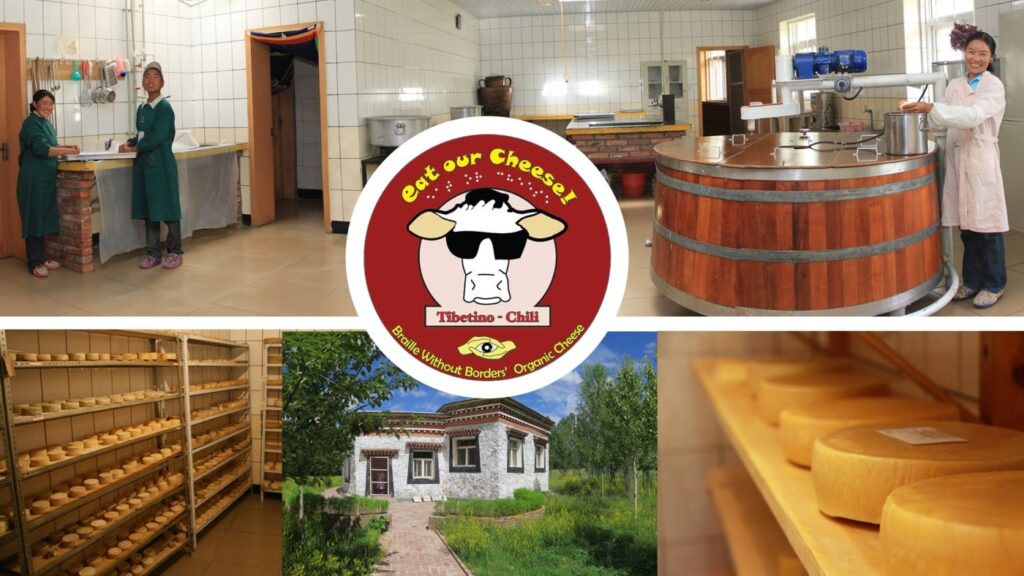
When we ran our training farm in Tibet, we had a cheese factory funded by the Dutch Embassy and operated by blind people. It earned an excellent reputation, initially for one simple reason: the quality of its cheese.
Norbu, one of our blind students, travelled to the Netherlands with one of our other colleagues. There, they learned cheesemaking from Marinus Post, a Dutch cheesemaker. What began with basic knowledge developed into skilled craftsmanship. They experimented with recipes, refined their techniques and trained other talented blind young people.
There were only a few trainees, however. They needed excellent mental arithmetic skills, meticulous hygiene and a willingness to experiment with new recipes.
We were fortunate enough to taste their creations ourselves: soft cheeses with walnuts from our farm, sun-dried cherry tomatoes, roasted onions, peppercorns, or with garlic. There were also richly flavoured hard cheeses similar to Parmesan. The results were truly delicious!
Our cheeses, that we named ‘Lhasarella’ and ‘Tibetino’, soon became something of a craze among travellers to Tibet, particularly French tourists. Some travelled 300 kilometres, not necessarily to see Shigatse, Tibet’s second-largest city, but to stock up on cheese.
Eventually, one of our products reached a French delicatessen shop in Shanghai, where customers could taste small samples.
The story was an excellent selling point: organic cheese from the Roof of the World, made by blind students and master cheesemakers. We even designed a funny logo featuring a blind cow.
The delicatessen’s owners were enthusiastic. Why not turn this success into a sustainable business?
An American business trainer shared their enthusiasm. He worked for an NGO specialising in microcredit and occasionally taught business administration to our ambitious blind young people in Lhasa and at the farm in Shigatse.
Together with the Shanghai shop’s management, he developed a logistics plan. The cheese would mature in specially designed wooden boxes during the nearly four-day train journey to Shanghai, arriving ready for sale.
The consultants calculated that the business might even cover the running costs of the entire training farm.
That sounded promising, didn’t it?
Then we did what Rohin demonstrated so effectively this week: we ran the numbers.
We prepared a detailed cost breakdown and examined what the proposed production would require.
Our cheese factory certainly had the potential to generate substantial profit. But achieving it could have come at a price far greater than anything shown in a spreadsheet.
Let’s start with the milk.
We wanted to make organic cheese from organic milk. That meant healthy cows, feed we grew ourselves and quality we could control.
But we had only 17 highland cows and grew just enough feed for them. Each cow produced around two and a half to three litres of milk a day. This was probably partly due to their breed, they were certainly not intensively bred Dutch Frisian dairy cows, and partly to their adaptation to the altitude. Our farm stood more than 4,000 metres above sea level.
Their milk, however, was particularly rich in fat and nutrients, contributing to the cheese’s excellent flavour.
How much cheese did the proposed business require? We asked the consultants.
“Oh, perhaps ten a day?” Ten wheels of cheese a day. No problem, you might think.
Apart from that we would need considerably more milk. Where would it come from?
Were there other farmers nearby?
Of course. But their milk did not meet our standards. Some diluted it with water without telling us, and we sometimes found traces of medication. Even if we could source suitable milk, another question remained: who would handle the extra production?
We had only four blind employees with the skills to calculate ingredients precisely, maintain exact temperatures, operate the machinery and keep the factory scrupulously clean.
And I mean scrupulously clean. An American ophthalmologist even wanted to rent the cheese factory to perform eye operations.
Our four master cheesemakers had developed their skills over many years. They knew their craft, understood the processes and knew exactly what mattered.
Where would we find more blind people who could be trained to that standard quickly enough to take on such demanding work?
The consultants had an answer. “Then just hire a few sighted people!”
That was the moment we almost abandoned our original purpose.
Through high-quality training, our blind employees had acquired specialised professional skills. They were not simply helping with production. They were the experts who made the cheese and ensured its quality.
Hiring sighted employees to expand production might gradually have shifted work away from our blind master cheesemakers. Our original aim, creating professional opportunities for blind people through skilled vocational training, could have slipped into the background. Expansion might also have compromised the quality that made the cheese so desirable.
We faced a choice. Did we want a highly profitable cheese business? Or a training farm where blind people could develop professional skills and greater independence?
We said goodbye to business as usual.
Instead of expanding at all costs, we focused on high-quality training and smaller quantities of excellent cheese. With our enthusiasm renewed, we continued selling it at cost price.
We gave up the big business idea, but held on to our real goal.
For me, this brings the story back to Rohin’s finance workshop.
Understanding financial theory and calculating costs had not stopped us from thinking economically. Quite the opposite: it helped us make an informed decision. Only by running the numbers carefully could we understand what expansion would mean for our social mission.
Business knowledge is far from unnecessary. It can protect us from being dazzled by an attractive idea. It helps us assess opportunities realistically, recognise risks and make decisions that remain viable over time.
But numbers alone cannot tell us what we want to achieve. A business plan can show us how to become profitable. It cannot automatically tell us whether our work contributes to greater justice, self-determination or social change.
That is why social changemakers must remember their original purpose amid all the excitement about profit, growth and cash flow.
We need both; business knowledge and a social compass. We also need a catalyst who can show that double-entry bookkeeping, cost-price calculations and break-even analysis need not be boring. Someone who turns dry numbers into an engaging story, complicated concepts into an understandable game, and sometimes reluctant participants into a group perched on the edges of their seats, hanging on every word.
This week, Rohin showed us how it can be done. And I wrote a song for him. It goes like this:
verse 1
When thinking of visions beyond personal plans
Most people would only give it a chance
If profit and loss is priced in the deal
“Stop dreaming” they say, “start thinking, get real!”
Pre-chorus
When singing the song of motivation
they counter with Cost price calculation,
And every thought of transformation,
is drowning in profit expectation.
Chorus
When we started with our team,
We were sure about our dream
And we were certain for the rosy days to come.
But then these questions start to pain
What makes your enterprise sustain?
Where is the capital that keeps your venture run?
Verse 2
When seeking for funding, they would offer a lone
They Just focus on income, yet our dream is unknown.
Our return of investment is the change we create
We suggest to invest in our mutual fate.
Pre-chorus
When singing the song of motivation
they counter with Cost price calculation,
And every thought of transformation,
is drowning in profit expectation.
Chorus
When we started with our team,
We were sure about our dream
And we were certain for the rosy days to come.
But then these questions start to pain
What makes your enterprise sustain?
Where is the capital that keeps your venture run?
We will soon share a link to a video that accompanies this song! So stay tuned!.
Learn more about kanthari at: www.kanthari.org
And, SPREAD THE SPICE is coming up on 17th and 18th October 2026.