Every year, kanthari participants step out of the classroom and into the real world for our annual Exposure Trip. The purpose is simple: to collect best practices.
Participants visit inspiring organisations, meet changemakers, ask questions, observe closely, and explore what makes an initiative effective, sustainable, and rooted in the needs of its community.
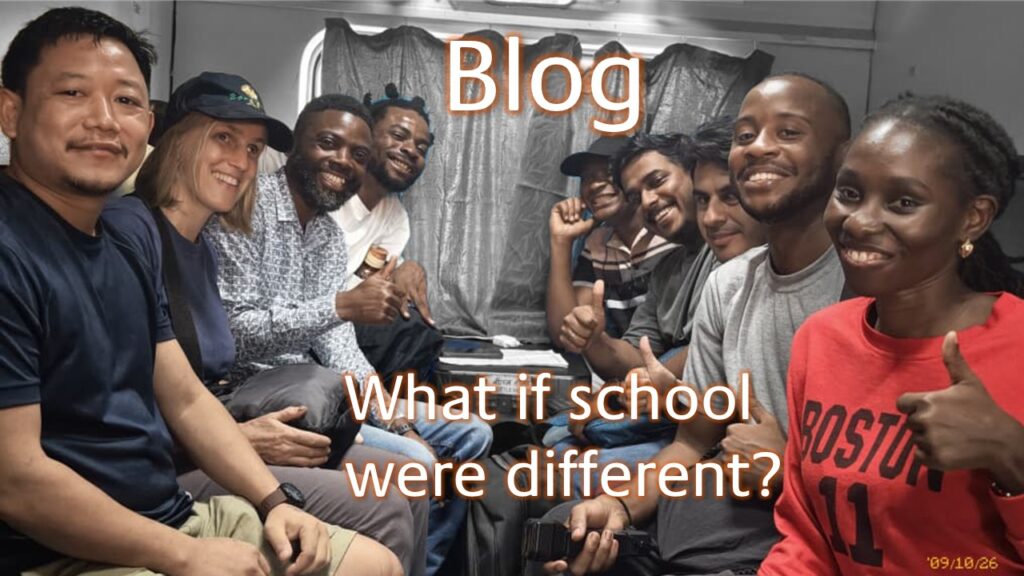
This year we had three groups: Learning, Environment and a social. This blogpost was written by Sabriye who joined the learning group.
What if school were different? Lessons from the kanthari Exposure Trip
I came along as a trouble-shooter, but in the beginning, I was the one that actually caused trouble, because I started the journey with severe fever and chills.
Later, Baluku got a painful stomach bug, then Ian got the flu, but none of us was willing to skip a visit. It was simply not possible to miss out.
Our group focused on education. And most of the organisations we visited were running schools, colleges, alternative learning centres, or schools for the blind.
Here are some of the highlights:
Just across the border from Kerala, deep in the forests of Karnataka, we visited a tribal school run by an NGO that oversees several schools in the region. This school follows an experiential-learning approach.
While India’s formal school system can be very rigid, alternative schools are flourishing. Many of them, however, still feel designed for more privileged families. However, this school was clearly different. It served children from some of the most neglected and marginalized communities. Most parents had not had a positive experience of school themselves. To help prevent children from dropping out, they asked that all students over the age of 12 live in the school’s boarding facility. The school did not look like a conventional school at all. Its classrooms were pentagon-shaped huts, strikingly built without windows or doors. Between them were practical learning spaces and workshops for electronics, tailoring, woodwork, and art. The campus also offered several sports and activity areas, including volleyball and football fields, running tracks, and spaces for creative games. One particularly memorable activity was a maths jumping game, which turned learning into movement and play.
All children wore unisex uniforms. This is something I got to realise a couple of years ago, when Niwas, a kanthari of 2021, blamed uniforms that are specifically designed for girls, with knee-long skirts and light-colored blouses, for being a hindrance to playing football, climbing trees and going bicycling. Here, every child wore the same dark shirt and shorts, so there was no need to worry about getting dirty. Another striking feature was that the teachers wore the same uniform too, making them not immediately distinguishable from the students.
“Teachers are seen more as travel guides,” the staff member who showed us around explained. “Children have many opportunities to learn according to their interests, and the labs function as small maker spaces.”
“And what about the outcome?” It is a legitimate question. Parents considering an experiential-learning environment often worry that their children may later struggle to find their place in a society that is strongly driven by performance, efficiency, and conventional academic expectations.
Our guide didn’t really answer our question at first. But we got part of the final answer at the next school we visited: a military school for especially talented children.
The impressive part of this school was a science park, a playground with all kinds of technical equipment that offered great insights into science: forces, friction, energy and many other different scientific concepts. Children could turn wheels made from different materials, predicting the moment when the first wheel would stop turning. There were swings that demonstrated how energy is transferred, like a pendulum.
All very impressive. But no child to be seen anywhere.
And the playground, or science park, looked so untouched that we started wondering whether it was actually used?
When we asked, the guide said, “Oh yes, when the science teacher asks them to come to the park to play, they will come.” Well, military school? Have fun when I give you the command to be happy?
While in the tribal school everyone was playing with balls, jumping through the maths boxes and running on tracks, even together with Baluku, who joined them, we heard the military students only from a safe distance. A beautiful choir of children’s voices, no one off-key, in harmony and uniform.
And of course, the question that was asked: “And what about the outcome?” And here it became interesting. In regional and interstate school competitions, the students of the free, experiential-learning tribal school scored the highest. And the students from the military school, who had to do an entrance exam to get in, were way behind.
This was even acknowledged by the vice principal. And now, we were hooked. What are the factors that make students remain in an always-curious mode? And how could these modes of wanting to learn be retained over the years and far into adulthood?
Abhijit, a 2015 kanthari alumnus, demonstrates through his organisation, project-DEFY, a radically different approach to education, and to the very idea of what a school should be. As he puts it: “A school without teachers.”
Yet it is not a school in the conventional sense. There are no teachers, but also no students, classes, syllabus, or curriculum. There are no age groups, fees, or uniforms, and the programme does not focus on one particular community. Everyone is welcome.
The youngest learner so far has been 10 years old; the oldest, 74.
All arrive with an idea, or simply with curiosity. Instead of giving ready-made answers, facilitators ask questions that help learners think through how they can develop and realise their own ideas.
The ideas can be big or small. Some do not work out, while others grow into viable businesses. One learner transformed broken laptop screens into televisions. Others have published a poetry book or created furniture from waste materials.
The space where Abhijit met us was housed in an old Karnataka-style home. Its floors were finished in red oxide, and as was common in traditional households, there was a grinding stone set integrated in the floor for preparing masala. It was a space with a friendly and cozy atmosphere. And Abhijit, with his usual relaxed focus, was a joy to listen to. He raised the question that had followed us throughout the trip: “Why is alternative learning only for the rich and beautiful, rather than for anyone who wants to try?” His maker spaces, or “Nooks,” as he calls them are not intended to replace regular schools. Instead, they offer a parallel space for anyone who wants to learn, not primarily for career reasons, but out of genuine curiosity and intrinsic interest.
Abhijit recommended that we visit another school with a completely different method, tailored to a more homogeneous beneficiary group, an affluent middle-class community with parents who are generally open to alternative learning methods but equally interested in high-quality education.
“Sparkling Minds”, a school on the outskirts of Bangalore, follows the toughest curriculum, the IGCSE, but in such a way that every child benefits, whether fast or slow. The structure of learning is child centric, so that the child leads the learning process, not the teacher. Everything, even reading, is framed as a game. But these are games not designed to promote competition with others, but instead to compete with oneself.
Thus, everything becomes an experience: Reading a book is not simply consuming a story. It becomes a journey in which the reader starts by predicting the benefit of reading a book, simply by looking at the cover and thinking about or anticipating how this book could help oneself on a journey. While reading, the students are asked to analyse the characters, their emotions, their choices and decisions, and what the reader himself or herself would do in this or that situation.
Reading is now focused on conscious visualization, imagination and critical questioning.
Why would the author choose this ending? What if the book ended in a completely different way? How would I have written it?
Equally interesting is the school’s attempt to develop the children’s emotional vocabulary. “Everything we do is communication. And communication means mastering language.”, so the administrator of the school who was an excellent communicator herself.
It became clear, many of us have only a very limited vocabulary when it comes to describing our emotions. We are happy, angry or sad. But what kind of happiness?
Why are we happy? And is happy always equal to happy? Again, through games, children learn a huge variety of ways to describe their inner feelings. And thus, they begin to understand why they think what they think, why they feel what they feel and why they do what they do.
The curriculum they follow is structured into small, digestible bites, offered through experiments, experiences, group work, self-research, debates, and and and.
They have mixed-age classes. Children aged 6 to 9 learn together, then 10 to 12, then 13 to 15. Only the tenth graders are alone.
After tenth grade, they have a project year in which they need to work on one intense project of their choice, and then they finalize high school with 11th and 12th grade.
All graduates have the opportunity to choose the best universities in the country, and they could even go to top universities in the US or Europe.
Yet many feel that the regular learning system of universities will not offer what they need. And thus, several graduates decide not to go on to further studies, but rather to follow their own calling. Who knows, maybe coming to kanthari? 🙂
On one full day, we had a workshop with Equibeing about the idea of a School for Excellence: a school which is not aimed at blind people, but at empowering natural problem-solvers who happen to be blind.
Equibeing is in touch with the Royal Family of Mysuru, which have supported initiatives for blind people for more than 100 years. Paul and I had a workshop in May in which we explained our ideas for such a school. And the Maharani promised to be part of it.
Paul and I see this as a side project of kanthari and maybe as an experiential learning space for our participants.
On this particular day in Bangalore, Anantha Lakshmi, the founder, divided us into three different groups. One had the task of designing a school, again, not for blind people but for problem-solvers who happened to be blind.
Another group was working on methods to offer science and maths.
And another group had to figure out how we could change the perception of blind people from being objects of charity to being seen as problem-solvers for the world’s challenges.
For more than two hours, we were discussing and going deep into each topic.
It was followed by a ‘short’ round in which we would present our ideas. But the short round became another hot seat, in which the following questions were discussed:
Why maths?
Why science?
How do we challenge these kids physically?
How do we get the public involved?
What are our perceptions of blindness?
I asked the question: What is the main other sense that substitutes for the lack of the visual sense?
All immediately suggested: hearing. Is it really the audible sense?
And then something clicked, at least with Cedric: “When the power is gone and it becomes pitch dark, I use my hands to look for my mobile phone, for my keys, and for my way to navigate through my room. I try to feel or ‘see’ with my feet.”
That was an eye-opener for all of us.
Although I know that hands play a much more important role when it comes to substituting the visual sense, and that the ability to read with the two index fingers is in a way similar to the ability to see with the central part of your eyes, I had never quite understood it this clearly. And now I understand why Paul acts so funny when he walks around after the lights go off. I usually only realize that the power is off when he starts waving his arms around and carefully steps forward, searching with his feet for the path in front of him.
At the end of this workshop, everyone was lost in their own thoughts, and some were even rethinking their projects.
Cedric is planning to encourage his LGBTQ participants, who will learn cooking and baking, to offer cooking workshops for blind people. And Miraj, who for the longest time has been wondering how he could offer education to girls in Afghanistan, is now thinking: Why not empower blind girls? After all, they are not seen as “bridal material”. Why not give them the opportunity to enhance their learning first? They could become teachers and psychologists and, in doing so, perhaps even become door openers for others.
We are all back on our campus now, with a backpack full of experiences, and grateful that we bonded so well and were able to appreciate each learning together.
I especially admired Cedric and Leah, whose beneficiary groups are not children and whose projects are not mainly about learning. Yet both were so open, so ready to integrate all the learning into their thought processes, and so willing to question and improve their ideas, that it was a real joy to listen to them.
We started our journey with great curiosity, and we ended it full of ideas and overflowing with impressions. And one more thing: we were able to learn because we were ready to reflect, question, debate and relive whatever we had experienced.
Learn more about kanthari at: www.kanthari.org
And, SPREAD THE SPICE is coming up on 17th and 18th October 2026.