
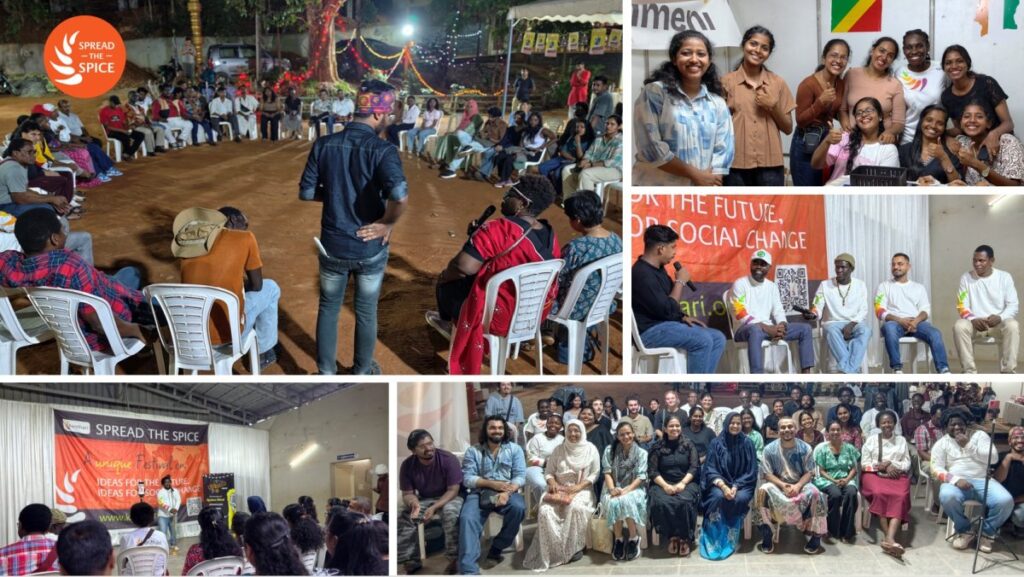
I am sitting at the side of the stage, listening to the speeches and debates, and must say, I am surprised by how much I am enjoying the atmosphere.
Well, perhaps what I enjoy most is the thought: It’s done! Finally! The event that made us sweat, steam, laugh, and sometimes suffer; the event that kept us waiting patiently, pushing here and there, and wondering whether things would eventually come together, has finally taken place. After six months of preparation, we can sit back, listen, and watch.
And while I am sitting here, with a roaring, fuming generator right behind me, surrounded by hungry mosquitoes, I remember Ravi’s regular request: “don’t forget the lyrics!”
Oh no! Really? Now?
Am I in the mood to activate all the relevant regions of my brain, my limbic system, and my hippocampus, just to keep my weekly promise?
For the past two months, Ravi has been editing short weekly videos offering a glimpse of life on campus. Each week, I contribute a little poem capturing what we’ve observed.
With the help of a music-generating app, we turn these poems and videos into musical snapshots of the struggles and highlights of life at kanthari.
And this week? The song is all about “SPREAD THE SPICE”, the festival organised by our kanthari participants.
I am about to start contemplating the rough path that brought us here when I hear Tiffany speaking. Tiffany is a kanthari alumna from 2013. She is talking about her journey after she completed the kanthari course and how she started her project, emphasizing how important it is not to wait for others to hold your hand.
She knows what she is talking about. She has become someone who spreads spice and fire herself, and the audience is cheering. I’m cheering as well, and I start typing one line, borrowing one of her statements:
“Who says that the world is waiting for you?”
That becomes the start of this week’s song!
“Who says that the world is waiting for you?
You need to convince them with all that you do.
Just talking is easy, let’s act and surprise,
By changing their mindset,
SPREAD THE SPICE”!
“SPREAD THE SPICE” is meant to be a learning experience. Our participants organise the event to find allies and supporters and showcase their ideas in stalls. Through this process, they are supposed to learn about project planning and team management and get started with fundraising. They must approach people, establish contacts, explain their projects, and convince others to take an interest in what they are doing.
And there is one little detail that makes the whole exercise particularly spicy: they have to do all this in an unfamiliar environment.
Of course, they don’t know the city, the culture, the language, or the people. They don’t know whom to approach or who might be interested in supporting their work. And so, during the preparations, the familiar chorus begins.
“How can you make us organise an event in a country, a city, that is not familiar to us?”
“How can you ask us to raise funds, if we don’t know potential supporters?”
And:
“We don’t know the language, the culture! How can you expect us to succeed?”
I have heard variations of these questions many times. And in a way, I do understand the uncertainty behind them.
Starting something new in an unfamiliar environment can be intimidating. It is much easier to work with people you already know, in a place where you understand the rules and speak the language. But stepping into the unknown is part of being a pioneer, so welcome to the club!
Learning through experience is one of the core principles of our curriculum. We don’t want participants simply to memorize theories about project management, fundraising, or marketing. We want them to put those ideas into practice and discover what it takes to make something happen.
And yes, they will make mistakes. Some approaches won’t work, some people won’t be interested, and some plans will need to change. That is part of the process.
In a classroom, a mistake often stays on paper. In the real world, the consequences can be uncomfortable, even embarrassing, for both the participants and kanthari. People may reject their ideas, question their approach, or criticise their efforts. Yet these experiences offer lessons that no classroom discussion can fully replace.
And as I sit here, watching the festival unfold, another verse begins to take shape:
“Who starts to act will set the trend,
Who draws the plan, will understand.
Owning the process means you know how to rise,
Don’t get discouraged,
SPREAD THE SPICE”!
Of course, the question is: Why are we putting all of us, the participants and the catalysts, on such a ‘battlefield’?
Well, perhaps because we had to learn the same lessons ourselves.
Let me take you back to the winter of 2004.
Paul and I came to Kerala for the first time. A few months earlier, Jim Yardley had published an article in The New York Times about our project in Tibet. He mentioned that we wanted to establish a larger training centre for social change-makers somewhere in southern India.
Actually, we had already told him that we wanted to settle in Kerala. And why Kerala? We both love water. We were tired of the Tibetan ice-cold winters and wanted a greener, warmer environment. We also wanted to be a bit more central in this world.
But knowing where we wanted to go was one thing. Knowing how to set something up was quite another.
We didn’t know the culture. We had no clue whom to approach. We couldn’t rely on an established network because we didn’t have one. But we were enthusiastic, and we had experience setting up a project in Tibet, which had been a completely unfamiliar environment for us back then too.
We had learned that if you want to make something happen, you cannot sit around waiting for the right people to find you. You have to get out there, talk to people, explain your ideas, and make your case.
Fortunately, one attentive reader of the newspaper article, Navin Ramachandran, opened the first door for us. Through him, we got to know his family, who somehow adopted us, and they introduced us to the wider community around Trivandrum.
We met Raja Bhadresh, a businessman who became a board member. Through him, we were introduced to the best project manager we could ever have dreamed of: Ajith Kumar. Ajith put together an amazing administration team that has been with us for more than 17 years.
Slowly, one contact led to another. Each conversation opened up new possibilities, and each introduction helped what had once seemed impossible begin to take shape.
And no, it certainly wasn’t always easy. We had to keep knocking on doors, following leads, and trying again when things didn’t work out. We learned to recognise opportunities and make the most of them. Above all, we had to persist.
By organising SPREAD THE SPICE, our participants get a small taste of that journey.
As these thoughts run through my mind, Tiffany says, “If you want to make a difference and take the lead, people may criticise you. They may not like what you’re trying to do. But as a changemaker, you simply cannot be everybody’s darling!”
Paul and I applaud emphatically. And I note down:
“Once YOU are in charge, you hear others complain,
Just follow your path, those who act will remain.
Working in teams means fire and ice,
Cool down the steam and
SPREAD THE SPICE”!
From our observations, the biggest challenge may not have been the task itself. Organising a one- or two- day event is an achievable goal.
The biggest hurdle was team dynamics.
Once the team was formed and responsibilities were shared, a blame game started. Criticism, accusations, finger-pointing, excuses: the entire toolbox of explanations for why things were not possible, came into play.
Those who took the initiative found themselves being targeted. Three of the main organisers stepped back from the tasks they had chosen for themselves.
It is difficult to say why. Some may have stepped back after honest self-reflection, feeling that others were better suited to the task. Others may have struggled with the persistent lack of engagement from their teammates. Perhaps some feared criticism of their own shortcomings, while others found it difficult to persevere as the work became a bit more challenging.
Those who felt a strong sense of responsibility and stayed on, often bore the brunt of the criticism, becoming increasingly frustrated.
Our advice to those who took their tasks seriously: Develop a thicker skin, become resilient, and take harsh criticism with a pinch of humour. That doesn’t mean ignoring every criticism. Some feedback is valuable and can help us improve. But we also need to learn not to let every negative comment discourage us from moving forward. Those who moved forward had learned. Not “involving oneself means missing out.”
Well, by now, the lyrics have become more than a collection of catchy lines.
And Paul, who is sitting next to me, adds the following:
“When someone says “never,” you answer “why not?”
Turn up the courage and give it a shot!
A spark shared with others makes flames twice the size,
Put doubt on the back burner, and
SPREAD THE SPICE”!
This is more than just a festival. It has become a reminder of what it means to be a changemaker: to act before everything is clear, to keep going when things become uncomfortable, and to learn from experience rather than hide behind excuses.
The atmosphere is lively, and I am happy to see visitors engaging with the participants’ ideas. Yet I cannot help feeling that the participants missed some valuable learning opportunities during the preparations.
They could have gained much more experience in reaching out, identifying potential donors, approaching supporters, and persuading people to become allies.
These are not abstract skills. They are essential tools for anyone who wants to turn a social vision into a sustainable project.
I understand that the participants were working in unfamiliar surroundings. But here is the good news: even if they have achieved a fraction of what they had planned at the beginning, they will still have a good foundation for whatever they do when they return home. And home is familiar territory. They know the language and the people, and they have their networks and their teams. But the challenges will be no less demanding, just different.
We don’t expect everything to work perfectly. We don’t expect our participants to know all the answers. We do expect them to try, to take initiative, and to discover what happens when they step outside their comfort zone.
An unfamiliar environment is not simply an obstacle. It is also an opportunity to explore new skills, discover resources, people, and possibilities we might never have encountered otherwise.
Learn more about kanthari at: www.kanthari.org
And, SPREAD THE SPICE is coming up on 17th and 18th October 2026.