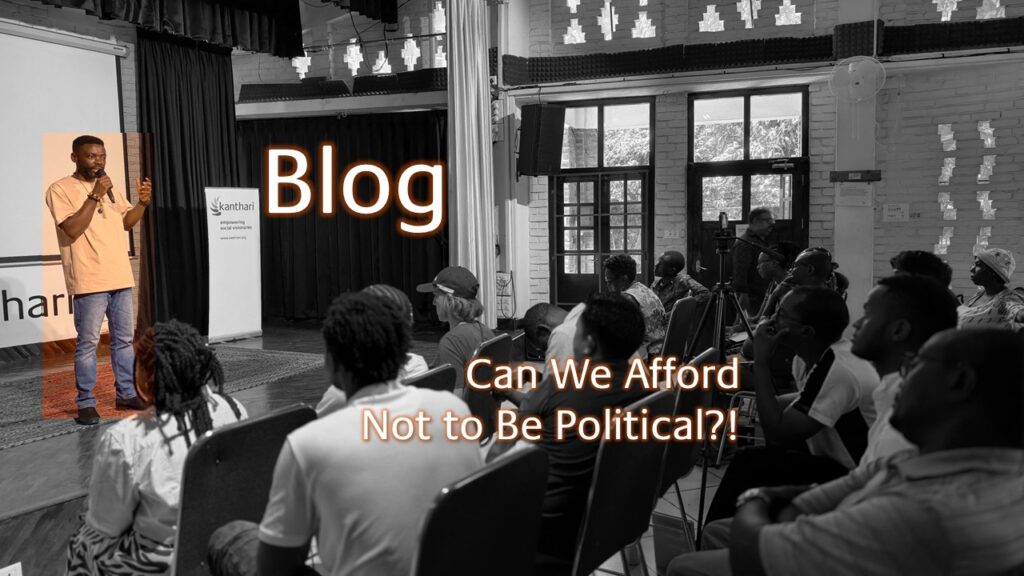
This week, shortly before an election debate, I overheard one of our participants, who is generally not afraid to speak up, telling one of the catalysts that he was not ready to get involved in politics. That made me think about what it really means to be political.
The word politics comes from the ancient Greek word polis, meaning “city” or “community.” Originally, politics simply referred to the affairs of the people living together in a community. Today, however, the word is often understood much more narrowly. When someone says a person is political, many immediately assume they are active in a political party. But being political is much broader than that. It simply means engaging in matters of public interest.
Since 2025, we have shaped our fictional country (which is part of the kanthari experiential learning) in such a way that participants have no choice but to engage with issues that concern everyone.
One third serves in the government, representing different ministries and making decisions. Another third sits on the Control Committee, keeping a close eye on the government’s actions and making sure money is spent fairly and transparently. The remaining third forms the opposition. Their role is to question decisions critically, challenge policies, and, when necessary, protest during debates, and sometimes even during coffee breaks.
Whenever I hear participants wanting to “chicken out” of political debates, I ask myself: Is that possible?
Can someone be a changemaker, advocate for the rights of marginalized people, and still claim not to be political? Isn’t almost everything changemakers do a matter of public interest? Why then choose the easy way out by saying, “I’m not political”? In our simulated country, freedom of speech exists, and a culture of open debate is there.
And then there comes the “but.”
“But in our country…” Yes. Most of our participants are right.
What can be done in our simulated country, with the worst possible consequence being that you might end up in the newspaper, can have far more serious consequences in many of their home countries. I grew up believing, almost taking it for granted, that the world would gradually become more progressive, more equal, fairer, and more just.
Today, the reality differs quite a bit.
Rights that were fought for and won during the 1970s and 1980s in many countries are slowly evaporating. They are melting away before our eyes. What often remains is an indistinguishable mush of accepted opinions that nobody is supposed to question. And whoever does question them is quickly labelled as ‘anti’, ‘anti-this’, ‘anti-that’ rather than being listened to.
I grew up in a time when joining demonstrations was considered almost a civic duty.
The first protest I attended was about women’s rights. I must have been around ten years old. Two feminist university students took my brother and me along. It was quite a sight: people singing, shouting, occupying streets, demanding an end to violence against women.
Then there were the protests in the Hofgarten, the public park behind our university. I think I was about eleven when Heinrich Böll spoke there and encouraged people to link arms and form human chains. Later came the peace demonstrations. One of the biggest was a star march in Bonn. At that time, I was attending boarding school in Marburg. Three friends and I asked our teachers whether we could participate. They happily agreed and even gave us money for the bus tickets. When other students complained that they also wanted a day off, our teachers answered very clearly:
“They don’t have a day off. They have a day of public protest.”
During my university years, I helped organize several demonstrations. One attracted more than 5,000 participants. Another focused on the sensitive issue of the Kurdish people’s struggle for freedom. That protest later became an example of successful cooperation between protesters and the police. Despite the emotionally charged topic, the entire event remained peaceful and was managed with mutual respect by everyone involved.
During our first years in Lhasa, the national government was constantly suspicious of us, seeming to believe we were somehow involved in anti-national activities. Our reply was always the same: “We are not involved in local politics. We are blind politically.” Eventually, they understood what we meant, though to make sure, they kept a close eye on us.
Everything that influences our lives, from being blind to caring about environmental protection, education, peace, or human rights, is political. Nowadays, wherever we go, these topics have become increasingly sensitive.
Why am I writing about this? Because India was boiling. Many young people, especially Generation Z, simply had enough. Enough of being pushed through an education system that measures degrees rather than talents. Enough of collecting certificates only to discover there are no jobs. Enough of being looked down upon. Enough of unfair treatment. Enough of examination papers being leaked before the exams even begin.
So here is my question: Can we actually afford not to be political? All of these are matters of public interest. And we cannot afford not to care.
Yes, there are limits to what can be said in public. Speaking out can cost organizations their licenses. It can cost individuals their freedom. In some countries, it can even cost lives. These realities cannot be ignored.
Some of our participants can practice taking a political stand here. But will they be able to do so once they return home? And if they can, how will they balance speaking up and remaining safe?
Well, let me end with one final word about our fictional country.
When we first created it in 2009, it often felt like a nightmare to live and work there.
Today, without changing very much, I sometimes have the feeling that the real world has overtaken us.
And suddenly our fictitious country appears more liberal than many countries I know, including my own.
Read more blog posts here
Learn more about kanthari TALKS on https://kantharitalks.org/