For the past week, I have not been sleeping well. The ‘wave dreams’ I used to have during my university years, and again when Paul and I first lived in Tibet, have returned.
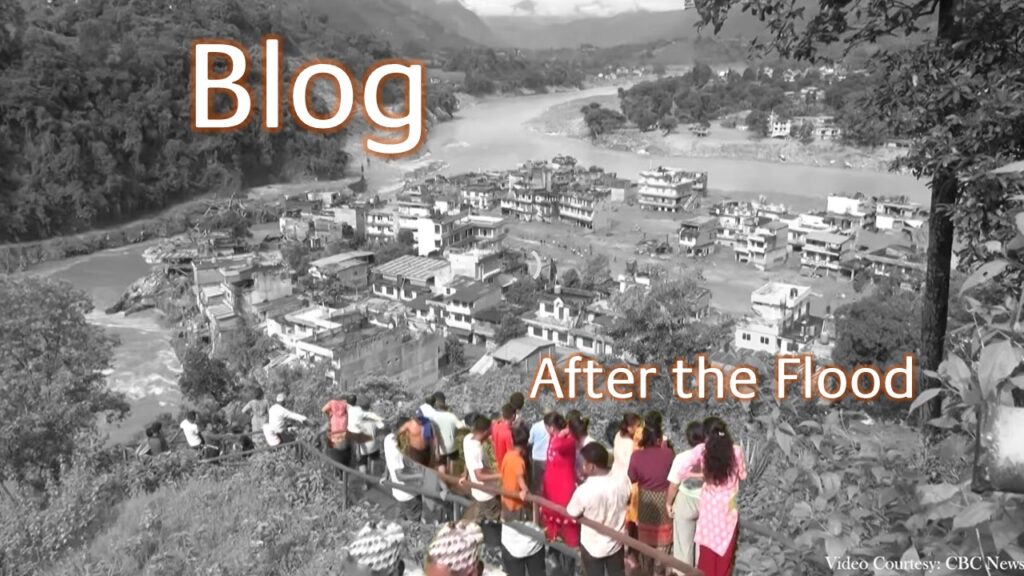
I think the dreams have returned partly because of the terrible news from the Nepal–Tibet border region, an area we know well from our many crossings between Nepal and the Tibet Autonomous Region.
Twenty-six years ago, there was a similarly devastating flood nearby, which reached us one day ahead of the actual disaster. It was also in August, around this time of year, when the Chinese authorities “kindly” pointed out to us that our visas were no longer valid and that we had better get out of the country as quickly as possible to apply for new ones.
At the time, flights were limited, and since time was pressing, one really should not overstay in China without valid papers, we joined a Red Cross transport. We later learned that our Land Cruiser had been the last vehicle to make it safely through to the border in Zhangmu. Another vehicle that crossed the same bridge a few hours after us was swept into the abyss by the flood, together with the bridge, and was never seen again. We also learned later that our Red Cross driver was stranded in the border town for two weeks, until the bridge was repaired and he could return to Shigatse. The devastation in the valley was far greater than we could have imagined. In 1998, as today, there was no effective warning system or reliable information on the Chinese side.
While still in Tibet, we had no idea what awaited us across the river in Nepal. And after the Nepalese border officials had welcomed us with great friendliness, we stood there stunned in front of entire stretches of road that had been washed away, bridges swept off their foundations, and enormous landslides that had hurled entire buses down into a 100-meter-deep ravine.What haunts my sleep today are the crossings of those raging rivers deep below us: the two of us, backpacks on our backs, balancing on a dangerously bouncing wooden plank. And the sliding and scrambling down a mountain of mud that was still dripping into the abyss. This must be what it feels like for the people fleeing today, just a few days after the catastrophe.
And all these flashbacks bring the dreams back, too. The terrifying image of a wall of greenish-brown water rising behind the rocks, blocking out half the sky and forcing everything through the narrow valleys. A tsunami made of rocks, trees, mud and water. Everything in its path, the border stations, shops and Nepalese restaurants, the houses and huts of the workers, bridges, tourist buses and trucks, was simply swallowed up. And in the end, nothing remains but a landscape of utter devastation.
I used to have these wave dreams frequently during times of stress. At first, the waves were nothing but a threat. Later, they began to dissolve, like a cloud you were flying through. Eventually, the cloud disappeared altogether and vanished from my dreams.
Looking back, I had the feeling that the dreams stopped because, somehow, Paul and I had managed to get a grip on the possible catastrophes. And although we went through many challenges back then, I always had this underlying sense of security that, little by little, things would eventually turn out for the better. And, in the end, they did.
Back then, we were the ones affected. And in my dreams, too, I was standing in the path of the wave, or even walking towards it.
Today, in my dreams, I stand at the side, not too far away. And since I am sighted in my dreams, I can see the wall of water and hear the rumbling that is all too familiar to me from the rivers coming down from the Himalayas. I watch everything and feel helpless in the face of such force. This side-on perspective probably has something to do with our current situation in life. At kanthari, too, we stand at the side of our participants, listen to their stories and ask ourselves how on earth they are ever going to get out of the mess.
Let’s take a little step towards the east, not far from the disaster area. One of our participants comes from Arunachal Pradesh in northeastern India. His village lies very close to the border with Myanmar and a long way from Delhi.
“We are far out and forgotten,” he says with a slightly uneasy laugh, “The children have to spend hours getting to the nearest school. The roads are poor, often flooded or simply impassable. People are farmers or traders. And when they cannot make ends meet, young people sometimes join armed rebel groups.
But armed groups need income, too. If someone has a little success, brings in a good harvest or makes a profitable sale, they are quick to show up and demand their share. In parts of Arunachal Pradesh, particularly in the border areas with Myanmar, extortion is part of everyday life.”
We asked him about the quality of the schools. “They are generally poorly equipped. Teachers do not stay for long, and the children have little motivation to learn.” He wants to change this and help build a better future for his village. But where can he begin?
Another participant is worried about girls’ education in Afghanistan. Since 2021, girls have not been allowed to attend regular secondary school beyond the sixth grade. Women are also excluded from universities. Afghanistan therefore remains the only country in the world where girls and women are formally denied access to secondary and higher education. He has three daughters himself and is extremely worried about their future. He has hardly any good memories of his own childhood, and he sees little hope for his own children. When we ask him what profession he would like to train them for, he says: “What are you talking about professions for? Isn’t education itself already enough of a goal?” Well, somehow, he has a point. If we give girls no education at all, they remain stuck in their development. Especially in remote areas, they are cut off from the outside world. There is a saying in Afghanistan: ‘The happiest are those who have not yet been born; the second happiest are those who die young.’ Where, in such circumstances, can anyone find the motivation to bring about change?
Then there is a participant from Zimbabwe who has been divorced twice, or, more accurately, has survived two violent marriages. She has two children and is ostracised and ridiculed by her own community.
She is branded a “Returned Soldier,” a derogatory term used in Zimbabwe for divorced women. The label reflects the intense social pressure on women to remain married, whatever the circumstances. Rather than being recognised as a survivor and an independent woman, she is pressured to return to the marriage she escaped, even though her former husband has threatened her life.
And we have a peacebuilder from the Republic of Congo. Wait! There are two Congos! the Democratic Republic of the Congo (DRC) and the Republic of the Congo, or, as he calls it, the NDRC, the “Non-Democratic Republic of the Congo.”
The DRC is the larger, better-known, or more notorious, of the two countries. We have already had two peacebuilders from the conflict-ridden region around South Kivu. Eric was kidnapped and tortured. He now lives in Sweden and continues to help from a distance. Elie is currently in neighboring Rwanda and cannot enter the DRC because of the Ebola outbreak.
The “other” Congo, the Republic of Congo, is a former French colony. As he puts it, the country remains heavily dependent on its former colonial power. Although the country is rich in oil and mineral resources, little of this wealth reaches the population. Large parts of the country remain difficult to access and have seen little development. Water is unsafe to drink, some schools have no roofs, and many people lack even basic healthcare. At the same time, dissent is swiftly suppressed. Protests are crushed, public gatherings are banned, and any sign of uprising is quickly silenced.
As we listen to these stories, we stand on the sidelines, horrified by the destruction and hopelessness, and painfully aware of our own helplessness. There is little we can do, except sit with them for a while and think alongside them. And yes, there are small glimmers of light: ideas that bring a little hope into all this bleakness. Small opportunities that, when recognized, can act like a starter motor. In a role-play suggested by Paul, a woman from Zimbabwe visits the participant in his region of Arunachal Pradesh. Her first question is: “Is there anything remarkable about your village?” He thinks for a long time. And eventually it occurs to him that the bamboo there might be the best in the country. And so he develops the idea of turning the villagers into bamboo experts. Bamboo can be used for construction, as food, to make dishes and furniture, and it can be processed into textiles. There are even bicycles made from bamboo.
The woman from Zimbabwe wants to transform the term “Returned Soldier” from an insult into a badge of honour. She even considers starting a rock band: The Returned Soldiers, a cool gang of divorced women who no longer must be ashamed of having survived a violent marriage.
On the contrary: they should be celebrated for being survivors. The Congolese participant wants to travel from village to village in a truck equipped with a mobile recording studio, encouraging people to talk about their situation. Their stories would then become song lyrics and eventually be carried out into the world through podcasts. Because while people are not allowed to express themselves politically through protests, poetry and art are encouraged. So: thinking through poetry.
His podcasts have now become “Poetcasts”, through which he wants to carry the voices of the Republic of Congo out into the world.
Only the Afghan participant is still staring into the distance, bewildered and lost in thought. The ideas of the others seem unable to reach him. What can he do? How can he rekindle the energy of the thinkers and doers, and of the many women and girls, in his country? Could digital learning programmes reach remote villages? Internet access, however, is far from universal. And when a device breaks down, there is often no one nearby who can repair it.
The situation is bleak. As with the devastation in Nepal, clearing the biggest obstacles will take time. Yet, he has already begun to work his way through the rubble, identifying one barrier after another. It is about developing new strategies for opening up breaches through which change can emerge. Some are already on their way. Others still have many obstacles to blast through.
Meanwhile, warnings continue along the Nepal-Tibet border. Following last Wednesday’s devastating flood, a lake formed behind a barrier of rubble, initially raising fears that another flood wave could occur. The water now appears to be draining away, at least partially, and the immediate danger of another breach has somewhat decreased. At the same time, another, larger reservoir of water is being monitored, so the danger has not yet completely passed.
Our thoughts are with all who are affected in Nepal and Tibet, and we certainly hope that the support they need will last…
Learn more about kanthari at: www.kanthari.org
An, SPREAD THE SPICE is coming up on 17th and 18th October 2026.